5 Differences between GEO and SEO that can help you appear in more AI chats
The goal of SEO has always been to appear ahead of your competition in Google searches. Now you want to be appearing in AI conversations too.


It’s an unavoidable truth now. Your customers are using AI tools to find information. It makes sense to try and improve your chances of being mentioned by ChatGPT and Gemini.
This article is part of a two-part series comparing GEO and SEO. This article looks at the big differences between the two, while the other article showcases the similarities. We’ll be referencing the other article a lot, so we recommend having it open in another tab and bouncing between both when it makes sense.
Clear distinctions
Generative engine optimisation, or GEO, looks and sounds a lot like SEO, but it’s got its own set of quirks to know about.
In an earlier blog we suggested practical steps to make your websites appear more in AI user searches. You may notice that some of the steps to improve SEO are just as applicable for GEO. That’s true, but the steps to improving SEO and GEO have their distinct differences.
The top three Sydney electricians cited by ChatGPT are all different to the ones shown in the Google search.
In this article we’re taking a step back to look at some examples and explore all the ways GEO differs from SEO.
SEO isn’t going anywhere
AI engines have created new ways for customers to discover you and your content. But it doesn’t make SEO any less relevant.
Google still processes over 16 billion searches a day, and Bing (still the world’s second most popular search engine) processes another 1 billion. That’s a lot more than ChatGPT's 2 to 3 billion prompts a day. But the AI user base is still quickly growing—its usage as a search tool increased by over 500% between May 2025 and May 2024.
GEO is all about optimising your online presence so large language models (LLMs) like ChatGPT and Google’s AI Overview (the Gemini-generated feature that appears above Google searches) can interpret your content, and mention or cite you.
Viewing the differences in practice
The clearest way to illustrate how SEO and GEO work in their own ways is to showcase them in action.
SEO in action
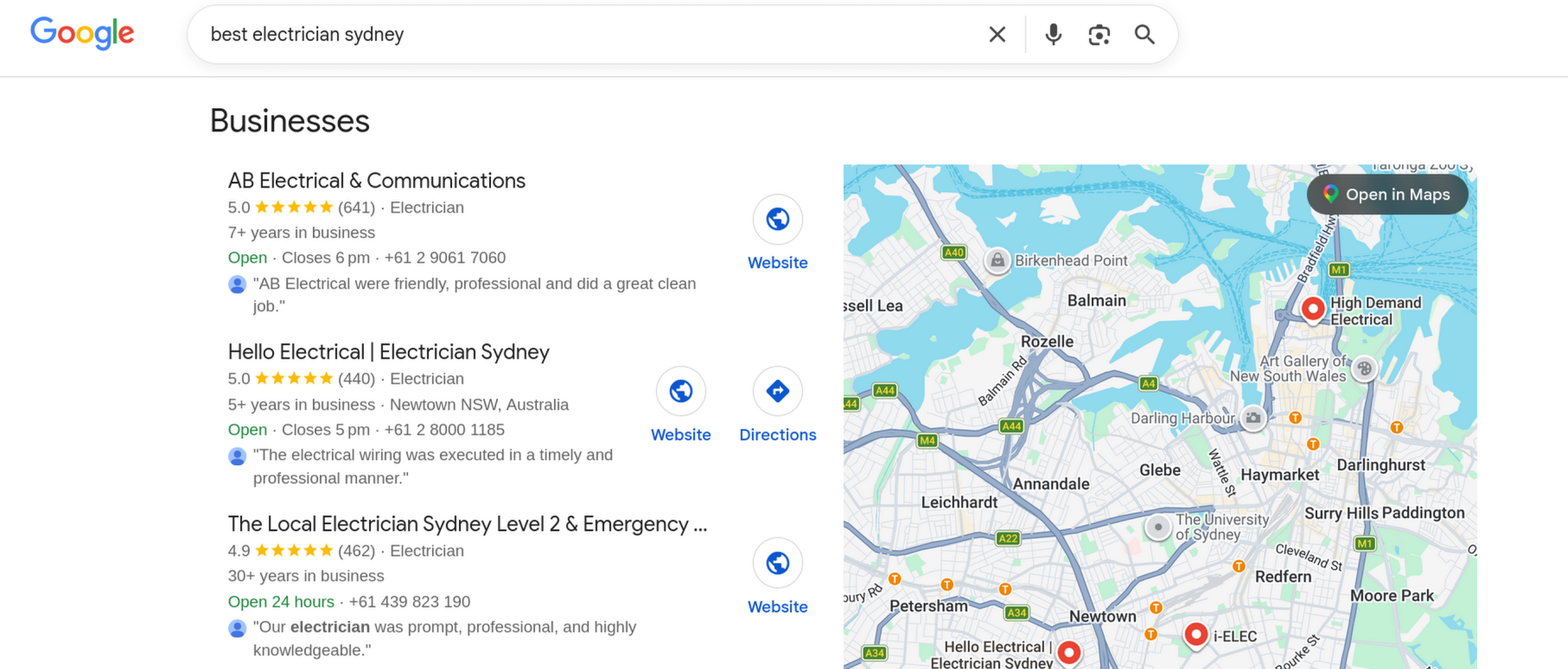 We searched "best electrician Sydney" on Google and got the above results. Ignoring the sponsored result at the top of the list, the electricians ranking highest all had 5.0 or 4.9 average Google ratings), and all operated in nearby locations.
But the rankings are not sorted entirely by review quantity or average rating, which means there are other SEO factors at play behind the scenes. The complete set of metrics used to decide rankings aren't made obvious to the user when searching.
GEO in action: ChatGPT
To contrast and compare, we asked ChatGPT: “Who are the best electricians in Sydney?”.
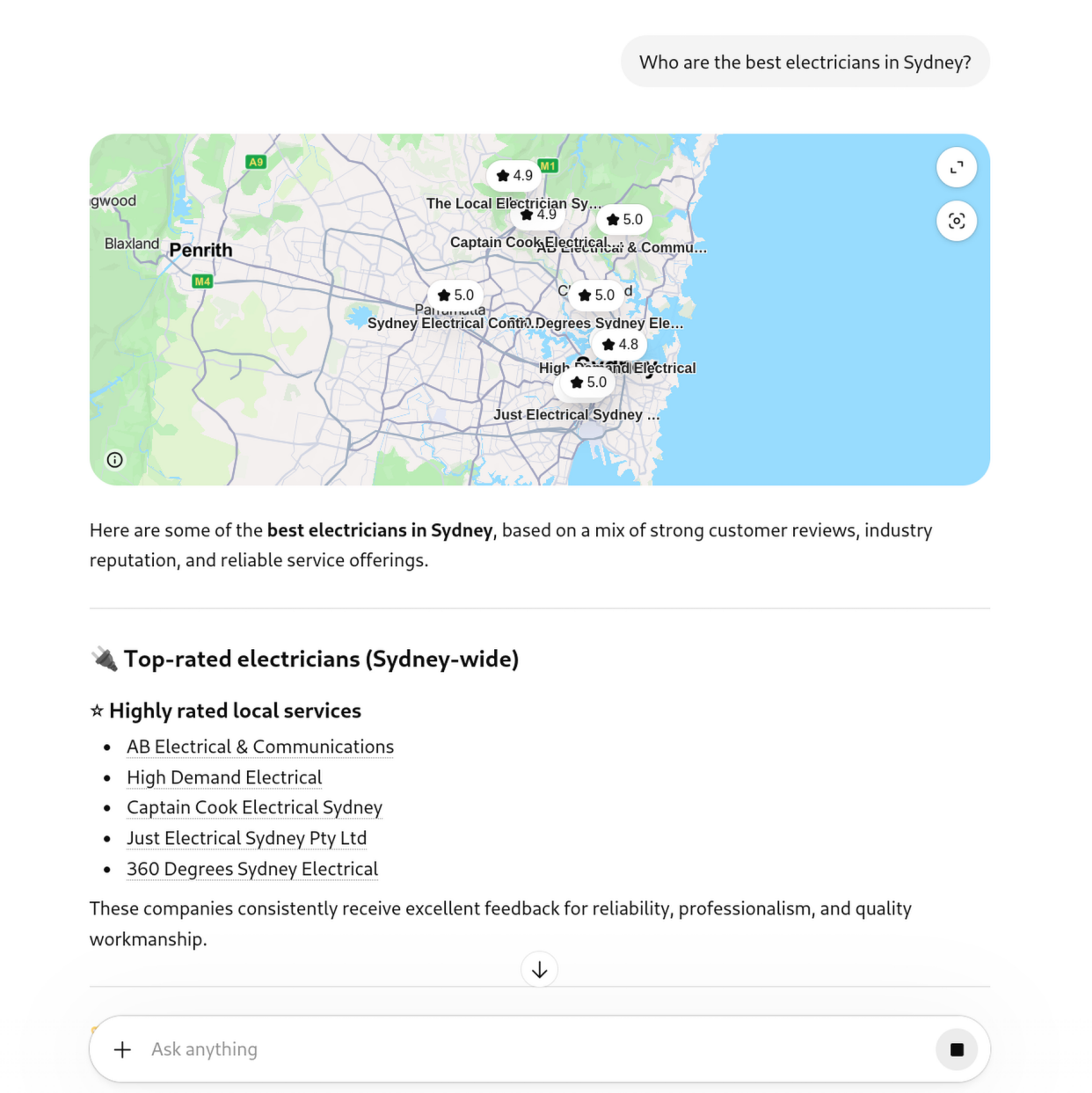 Of the Sydney electricians cited by ChatGPT, all but one was different to the ones shown in the Google search. ChatGPT is seemingly more transparent about its curation process, stating that it chose the electricians it cited based on reviews, reputation and service coverage within Sydney.
Instead of giving us a preview of each business’s website, we’re instead presented with three summarised bullet point descriptions of each business. There is a link to each plumber’s website, but you only see it if you hover your mouse on the business name. SEO is about getting clicks to your site, GEO is about being talked about. One system is designed to send users away in the right direction, while the other is likely to offer to keep chatting (i.e. keep users where they are).
GEO in action: Google AI Overview
We also prompted Google AI Overview to see another example of how GEO answers compare with both the regular Google Search and ChatGPT.
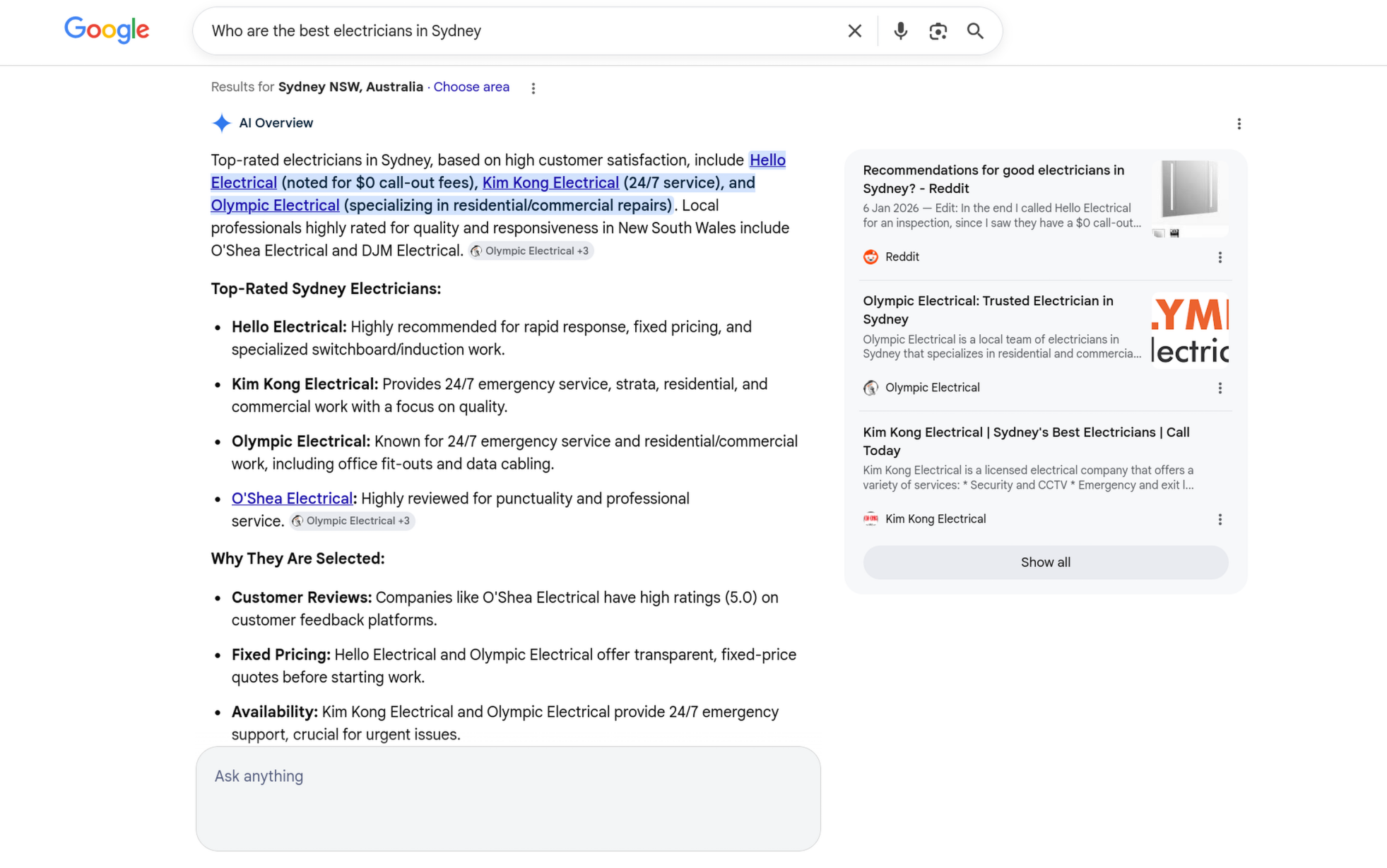 There was some citation overlap with the Google search results (particularly with the first citation), but otherwise Google’s AI Overview seemed to be drawing from a different pool of options. We investigate the overlap of results much more deeply in our blog about the similarities of SEO and GEO.
If it wasn’t already clear, ranking high in Google doesn’t guarantee you’ll show up in AI citations.
The similarities are important to consider (that’s why we wrote a whole article exploring the similarities) but it doesn’t mean you should SEO and GEO them the same way. Some of the differences are glaringly obvious, while others are subtle.
Difference #1: User queries are written differently
One of the more obvious differences between Google search and using AI tools is the way users write their queries. Google users usually construct search shorter keyword based queries, whereas AI users write longer and more conversational prompts.
In practice this means considering more than just keywords. Traditional SEO involves steps like incorporating targeted keywords (that people would use to find your business) in your content to rank high on search engines.
Related article: Expert Interview: SEO with long-time specialist Ash Nallawalla
SEO research is a mature discipline with everything from free tools like Google Search Trends to paid suites like Semrush. But if you want to know what people are typing into ChatGPT, you don’t have the same level of knowledge available to you. With GEO, you’ll instead need to consider how your content is answering the exact questions that users would be asking in their prompts. AI citation tracking tools exist but are not yet as thorough and precise as SEO tools.
When we were trying to find an electrician near us, searching “best electrician Sydney” and “Who are the best electricians in Sydney?” involved us essentially asking the same question, but written very differently for the different tools. Your content needs to answer the user’s search or prompt differently.
Difference #2: Content is delivered differently
AI and Google searches deliver information to their end-users in markedly different ways.
Search engines provide users with headlines and links to visit a website and learn more. Google’s SEO documentation explains that when creating content for search engines you should create “content primarily to help people, content that is useful to visitors if they come to your site directly”.
This means you’re primarily looking to provide a great web reading experience for the end-user, because that’s the content that is ultimately being delivered to the searcher.
On the other hand, AI engines pull snippets of content from a website, generate answers, and then cite the sources in their longform responses. The big change here is that AI users don’t even have to click on your site to learn about you. All the information they need will likely be summarised inside their conversation with the AI. What the AI quotes about you or anything else is largely out of your control, because the LLM is also using information from other websites and online sources to inform its response.
Instead of optimising specific pages, you’re optimising snippets for an AI to extract and cite, and potentially compare and contrast with what others are saying. You want to prepare content that AI-driven platforms can easily interpret and cite you in their responses.
AI engines are looking for snippets of articles that answer questions in a self-contained manner. If a paragraph you’re writing could be pulled directly from your page and used by ChatGPT to answer a question, then you’re on the right track to being cited by AI tools.
This can also pose a challenge of metrics. For example, website traffic doesn’t include LLM citations if the AI user doesn’t actually visit your website.
Difference #3: Authority is gained differently
When trying to improve SEO, authority is gained through other websites mentioning and linking to your site (known as backlinking).
With GEO, authority is instead gained by being referenced in a wider variety of external places.
The most successful and high-budget sites and brands are likely to have videos that mention them, and discussions about them on Reddit both boosting their GEO. It’s what the AI models are looking at when considering a source’s viability.
That’s certainly not easy to achieve, but a good social media or crowdbuilding strategy can play a part in getting one over your competition.
Difference #4: Content needs to be updated at a different cadence
LLMs have a very strong recency bias. To make the most out of GEO, content must stay fresh and up-to-date to satisfy the AI’s recency bias and continue being cited.
With SEO, quality evergreen content can stay relevant and rank on Google for years. Updated and fresh content is still preferred in ranking, but LLMs seem to have a stronger recency bias than organic Google search.
Difference #5: Success doesn’t look the same
Wins are measured differently. SEO measures success in terms of rankings and traffic. GEO aims to gain citations within AI conversations.
Good GEO can leave people more informed about you without leaving any trace that will appear in your digital analytics. Even if you do gain website visitors, clicks from tools like Google's AI Overview have the same referral data as clicks from standard search results.
ChatGPT names itself as a source, which is helpful, but overall it’s harder to tell if your GEO efforts are paying off compared to SEO. The best way to tell is by using Google Analytics or a similar tool to track these metrics and see how they change over time. You can use Google Analytics to see how many users visited your website based on ChatGPT citations.
Working in tandem
Optimising your website for AI engines and Google searches require different approaches . You can’t just copy and paste your SEO approach and expect ChatGPT to cite you in its answers.
You don’t need to start your efforts from scratch though. Your SEO and GEO efforts should work in tandem. If you’ve already invested lots of time and energy into SEO, you’ll already be a foot ahead in the GEO journey.
Stay in the loop, things will keep changing
Understanding how SEO and GEO differ, and the unique way search engines and AI tools work, is an important first step. To optimise your website so that it appears above your competition in Google searches and in AI conversations you’ll still need to spend a lot of time doing your own research to stay ahead, and keep creating content optimised for both.
One final note: GEO in particular is a constantly changing space, and will continue to advance and change as AI models evolve. Today’s best advice could always become outdated overnight. If you want to outdo your competition at the AI citation game, pay attention when you see news about AI algorithm changes or major LLM updates.
Photo by Sanket Mishra from Unsplash
Hosting and domains
What can we help you with?
Web Hosting
From $8.95/mo
Domains
From $12.50/yr
WordPress Hosting
From $8.95/mo
Virtual Servers (VPS)
From $19.95/mo
Get in Touch Title
Give us a call on 0800 454 537 to chat with one of our friendly team members.
Solutions link textPeople Sharing The Love
Fantastic support. Good pricing ...and a control panel that just works without trying to up-sell and randomly include extra things I didn't ask for.
So impressed, I'm migrating domains from a number of other providers who struggle with one or more of the above.

Great support when things go wrong. I patronised more than a dozen web hosts during my career, and I would say MyHost has one of the best support services that I have encountered. I've been with them for seven years, and I've been a very satisfied customer. Highly recommended! ★★★★★
