Don't Get Scammed! Phishing Emails Target MyHost Customers
Phishing attacks that target our customers are becoming more common. Here are the scam emails that we're aware of, and some advice for keeping your account safe.
Phishing attacks that target our customers are becoming more common. Here are the scam emails that we're aware of, and some advice for keeping your account safe.
Some simple steps can help you avoid phishers and scammers who want your data and your money.
If you ever receive an email about your domain, web hosting, or MyHost account and it doesn't look quite right, we are here to help. Forward the email to [email protected] and we'll confirm whether it's genuine or not.
This also lets us identify phishing attacks and warn other customers.
When you register a domain, you are required to save multiple sets of contact details as part of that registration. Some of that contact information will become public information, available via a WHOIS lookup.
Some scammers harvest this contact information and then impersonate your domain provider (e.g. MyHost). You can hide your email address and other contact information by adding Privacy Protection to your domain. Read more in the blog or see how to add Privacy Protection to your domains.
Even if someone gets their hands on your password, 2FA blocks them from logging in without an extra code from your phone. Learn how to manage 2FA in the Knowledge Base.
Some scams will spoof or impersonate our website. If they trick you into entering passwords or other details, that's a problem. Check the domain that you're on and make sure that it really is us:
myhost.nzmy-host.aumyhost-clients.com (this is the only domain where we collect credit card details)If you've been hacked, or you're worried that you might have been, there are multiple passwords to change.
Received a fishy email? Check whether it's listed here, or forward it to [email protected] and we'll let you know whether it's genuine.
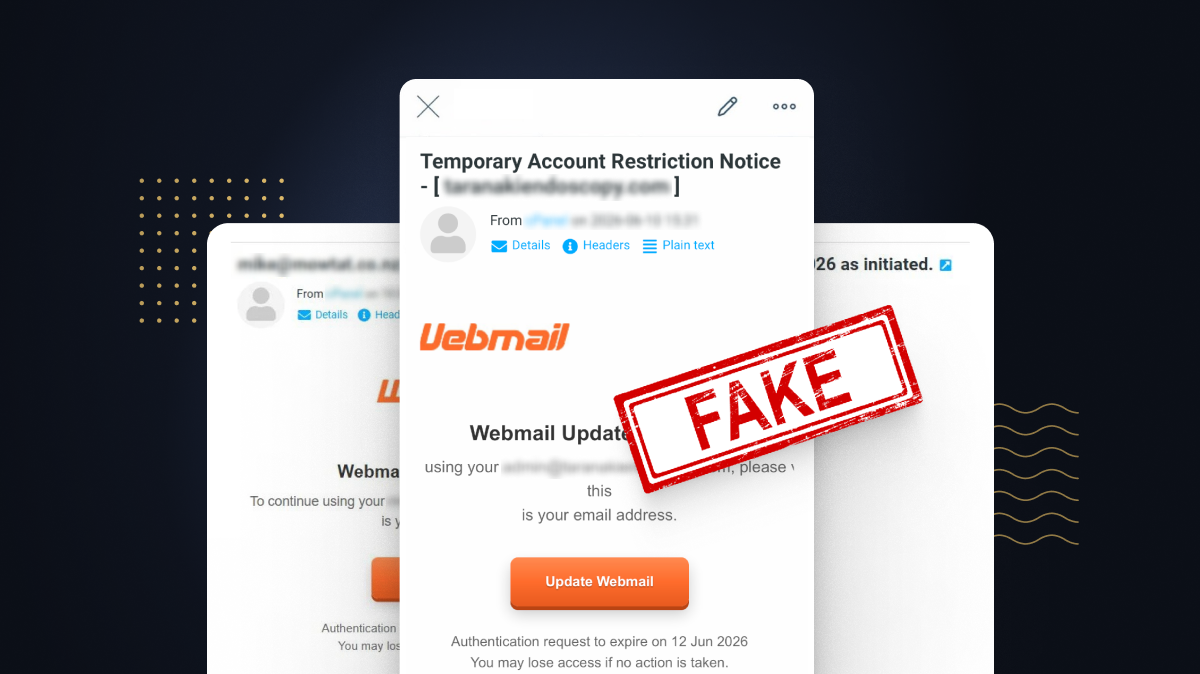
Date: 10 June 2026
Apparent sender: cPanel
Fake email subject lines may include:
Link text (do not click): Update Webmail
Target: Your password
A fake email impersonating cPanel links to a scam website, despite the link text pretending to go to Webmail.
We advise customers who have logged into the fake page (or if you're unsure) to change their password. Coincidently, this phishing attack was identified on the same day that we announced compulsory 2FA on all MyHost accounts.
Date: 18 March 2026
Subject line: Renewal notifications for: example.com
Apparent sender: DRNS New Zealand <[email protected]>
Link text (do not click): View invoice
Attachment (do not open): PDF with a filename like Invoice_136815.pdf
Target: Your money
If you have received one of these emails it will have shown your real domain and contact details. The invoice is NOT real and the payment details are fraudulent.
This is a third recent attack from "DRNS" or "DNRS". It contains links that open a convincing-looking website for a fake company that claims to be a domain provider.
Do NOT pay the invoice. You can alway check your domains' actual renewal date and amount by logging into your MyHost account.
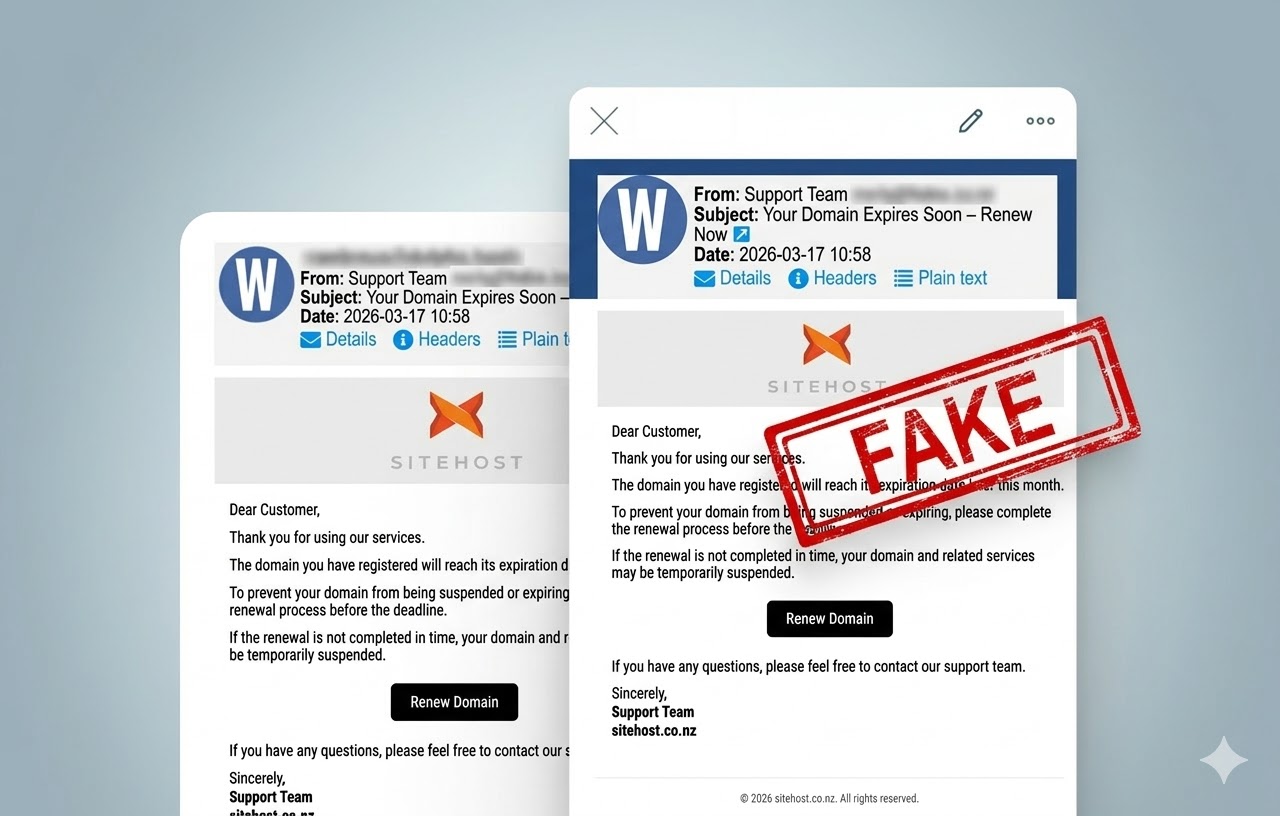
Date: 17 March 2026
Subject line: Your Domain Expires Soon – Renew Now
Apparent sender: Support Team. <[email protected]>
Link text: Renew Domain
This is similar to other recent attacks, where a phishing email targets domain customers of both MyHost and our sister company SiteHost. The fake renewal email links to a scam website.
We advise customers who have logged into the fake page (or if you're unsure) to change their password. We also advise all customers to enable two-factor authentication.
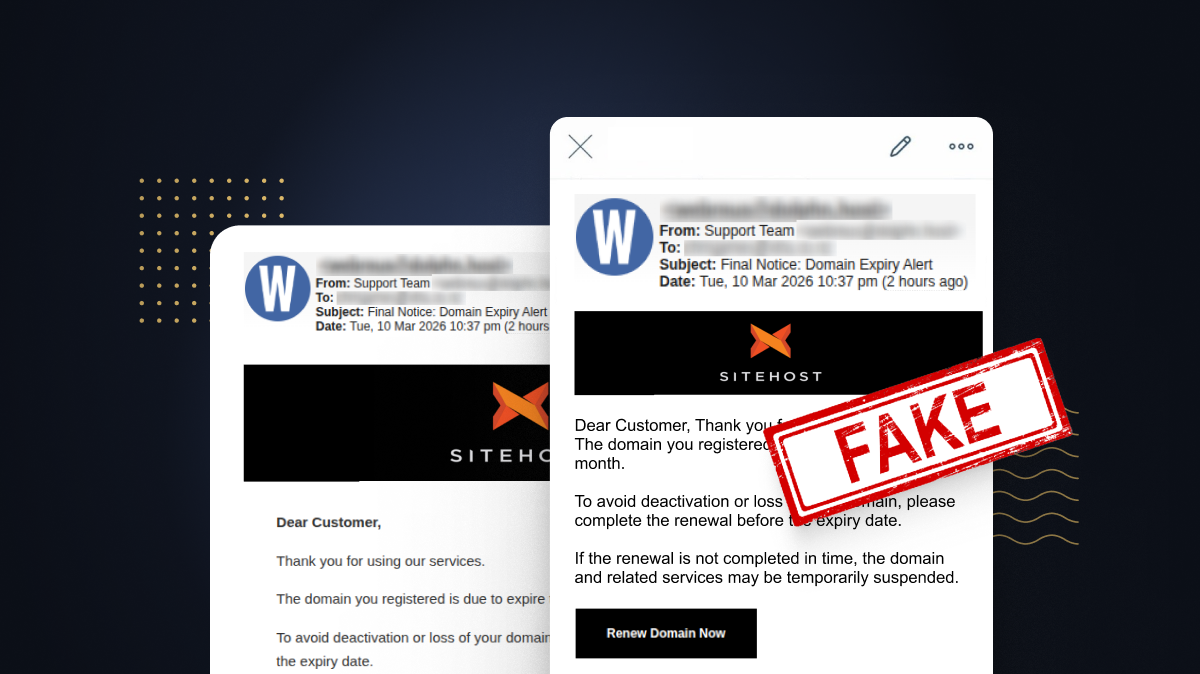
Date: 10-11 March 2026
Subject line: Final Notice: Domain Expiry Alert
Apparent sender: Support Team <[email protected]>
Link text: Renew Domain Now
This phishing attack targets domain customers of both MyHost and our sister company SiteHost. As you can see above, the header image in the phishing email uses SiteHost branding.
If you have logged into the fake page (or if you're unsure), change your password. If you are not already using two-factor authentication, enable it ASAP.
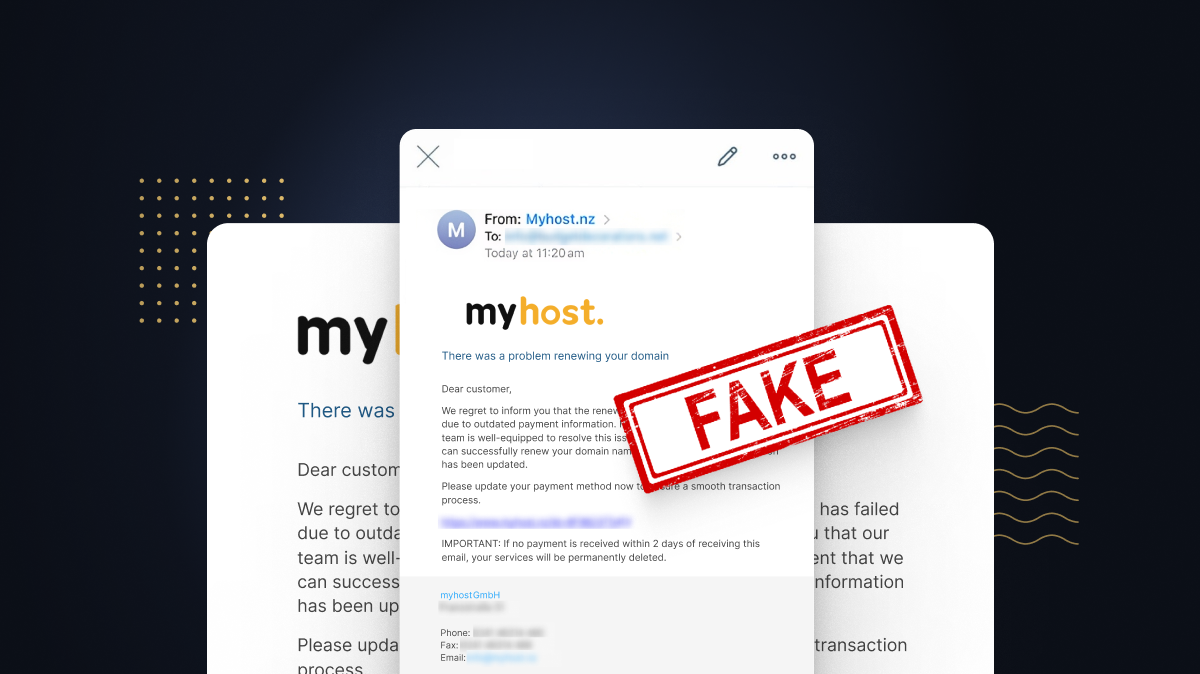
Date: 21-23 February 2026
Subject line: Renewal of your domain name failed !
Apparent sender: [email protected]
Link text: 'https://www.myhost.nz/id=6F9823T54D/'
A fake domain renewal email that links to a scam website, despite the link text pretending to go to myhost.nz.
We advise anyone who has logged into the fake page (or if you're unsure) to change your password and set up two-factor authentication.
Date: 13-14 February 2026
Subject line: Renewal notifications for: www.example.com
Apparent sender: [email protected]
Link text: 'View Invoice'
Earlier attacks have come from names like "DRNS" and "DNRS NZ". This time around, a fake website has been created to make the sender look legitimate.
Every .nz domain registrar has received this warning from the DNC:
The Domain Name Commission (DNC) is advising all .nz registrars to remain alert to phishing email campaigns that impersonate registrars and target domain name holders.
Two recent reports indicate that malicious actors are sending emails that appear to originate from legitimate registrars, often requesting .nz domain name holders to renew their .nz domain name via clicking on a phishing link or by paying a fraudulent invoice.
The reports indicate that the phishing emails may use branding, registrar names, or language designed to closely resemble legitimate registrar communications or even spoofed version of the registrar's website.
This is an unprecedented warning, and a sign that phishing is becoming a bigger problem for domain holders.
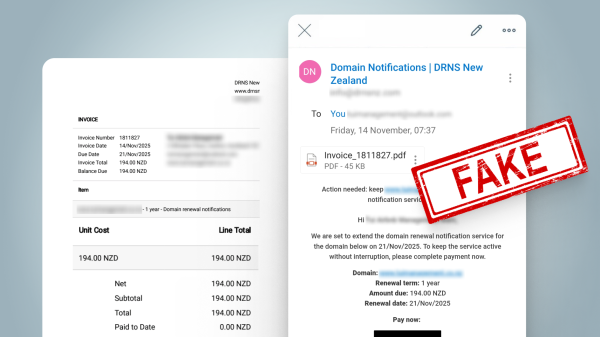
A fake domain renewal email with a PDF attachement and a link to a scam website.
Subject line: Domain Notifications | DRNS New Zealand
Apparent sender: <[email protected]>
Link text: 'View Invoice'
Attachment (DO NOT OPEN): PDF file with a name like 'Invoice_1811827'
Sender: [email protected] or [email protected]
Subject: CRITICAL: Your website <example.com> is at risk!
Recommended WordPress patch: CVE-2024-46188 (which is a fake code - this patch does not exist)
More details: Spam emails about WordPress vulnerabilities in the blog.

This attack targets domain customers of both MyHost and our sister company SiteHost.
Sender: [email protected]
Subject: Note on service renewal
Link text: "Log in To Control Panel"
Quick response to call, friendly manner, superb understanding and technical knowhow. Problem quickly resolved. ★★★★★

The support team always seem to go above and beyond, honestly couldn't ask for anything more.

Awesome Customer Support on a Sunday. Quick responses and solutions. Always patient and friendly! Thank you so much peeps! ★★★★★