Why our servers use NVMe storage, and why it matters
You don’t want outdated server hardware causing slow page load times. When it comes to server hardware, there quite simply is no storage faster than NVMe SSDs.


The faster the servers running your website, the faster your website will load. Faster website loading speeds means happier customers and increased SEO.
That’s why at MyHost we use the fastest storage around—NVMe SSDs.
NVMe SSD storage is standard issue across all of our Web Hosting (including WordPress Hosting and Website Builder) and Virtual Private Server plans. Keep reading to find out why it’s such an important ingredient that keeps your websites running at high speeds.
Speedy history of storage devices
To run websites quickly, Web Hosting servers need to be built with high quality hardware. And one of the most important components for handling your website’s data is the server’s storage device.
Different storage devices run at different speeds. Back in years past, hard disk drives (HDD) were the standard computing storage solution. In the early 2010s, solid state drives (SSD) started becoming the more popular choice, in large part because they store and retrieve data significantly faster than HDDs.
When SSDs first arrived they were usually connected to the rest of the server using the same cable connector technology as HDDs—known as the SATA interface. But this introduced a new bottleneck. SATA SSDs were so much faster than HDDs that the SATA connection struggled to keep up.
Since then, innovation has focused less on SSD storage technology and more on the connections that transport data in and out of SSDs. And that is what led to non-volatile memory express (NVMe) SSDs.
Faster and more efficient than anything else
The terminology gets confusing but it’s worth remembering: while all NVMe drives are SSDs, not all SSDs are NVMe.
NVMe is a technology that helps SSDs run even faster and more efficiently than ever before. NVMe SSDs provide the fastest data transfer speeds available of all storage types.
We’ll save you the bore of explaining exactly how it works in terms of hardware. The most important thing to know is that NVMe SSDs are about 10 times faster than SATA SSDs.
If you care, the stats are here
You don’t need to take our word for it—comparing NVMe performance stats to SATA SSDs options speaks for itself.
Input/output
The industry standard unit for storage device performance is Input/output operations per second (IOPS), which measures how much data the device can read and write in one second. The higher the value, the faster the device.
There’s two main ways of testing IOPS: one method reads and writes data in a sequential order like a book, the other accesses data from random locations on the drive and reads them, like picking random pages of a book to read paragraphs from. Without going into too much detail, random IOPS tests are more useful for assessing performance as it more closely simulates how storage is used in a web server.
The latest enterprise-grade NVMe SSDs can record up to 1.2 million IOPS on a random read test, and 950,000 IOPS on a random write test. SATA SSDs on the other hand max out at around 98,000 IOPS on random read tests and 88,000 IOPS on random write tests. Sequential tests show much the same.
Latency
The other metric that matters here is latency, which is the amount of time you spend waiting for an operation to happen.
Latency is assessed by measuring the time it takes from you making a request from a server, to data being received in your browser. Because the process happens so quickly, latency is usually measured in milliseconds or even microseconds.
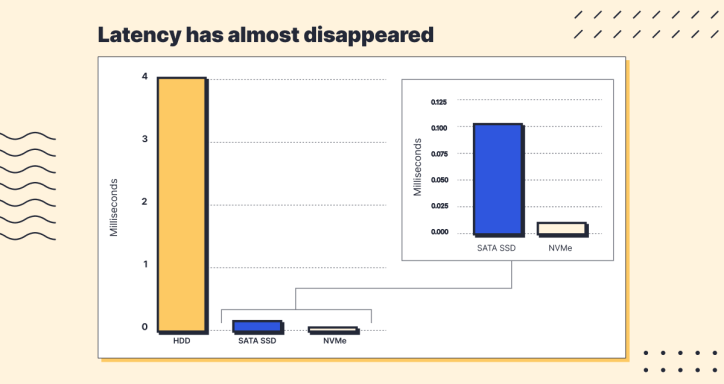
SATA SSDs have read response times of 120 microseconds, and write response times of 180 microseconds. NVMe drives on the other hand respond to read requests in 15 microseconds, and write requests in 20 microseconds. Reminder, that’s measuring millionths of a second.
The data makes it clear: NVMe SSDs are around 10 times faster in throughput and operate with more than 10 times less latency than SATA SSDs.
NVMe and Hosting
We know there’s a long list of things to consider when choosing a Web Hosting provider, but websites can only load as quickly as the hardware inside the server permits. NVMe drives reduce latency, meaning the server responds to your user’s requests much faster.
There are flow on positive effects to having your pages load quickly. Google considers page load speed when ranking pages, meaning the faster response times and lower latency provided by the NVMe directly contributes to better SEO.
The most important thing to know is that NVMe SSDs are about 10 times faster than SATA SSDs.
With NVMe storage your website can load faster and handle more traffic. To get clued in about every part of the Web Hosting equation, check out our Web Hosting Shopping Guide.
Another quick tip: if your website is built on WordPress, you can use PHP Vitals to see exactly how fast your host’s WordPress Hosting hardware is.
You want the quickest servers
If you care about your website’s load times (which you really should), then you need to know your servers are kitted out with the best and fastest hardware. That’s why NVMe SSDs are the standard here at MyHost.
If you’re hosting your website with us you can rest assured that our Web Hosting hardware is helping provide you with lightning quick load speeds.
Photo by Marc Pezin from Unsplash.
People Sharing The Love
“MyHost should definitely also be your host. Fantastic packages and efficient service, supported by approachable management.”

I've tried a bunch of others and I recommend MyHost without hesitation - MyHost offers exceptional value, great features (usually found on over-priced services) and second-to-none help. Do you guys ever sleep?

Awesome service. Answered every question super fast. Guided me through the process and followed up consistently to make sure everything was OK. Just awesome service. Couldn't be happier. ★★★★★

Hosting & Domains
See what's on offer from MyHost
Web Hosting
From $8.95/mo
Domains
From $13.50/yr
WordPress Hosting
From $8.95/mo
Virtual Servers (VPS)
From $19.95/mo
Any questions?
If you want to know anything about web hosting, domains, or building your own site, we're here to help.
Contact us