How to get your brand cited in AI chats: 6 things GEO and SEO have in common
Searching for information online has changed. Appearing ahead of your competition in a Google search has long been the goal of SEO. But now you want to be appearing in AI chats too.

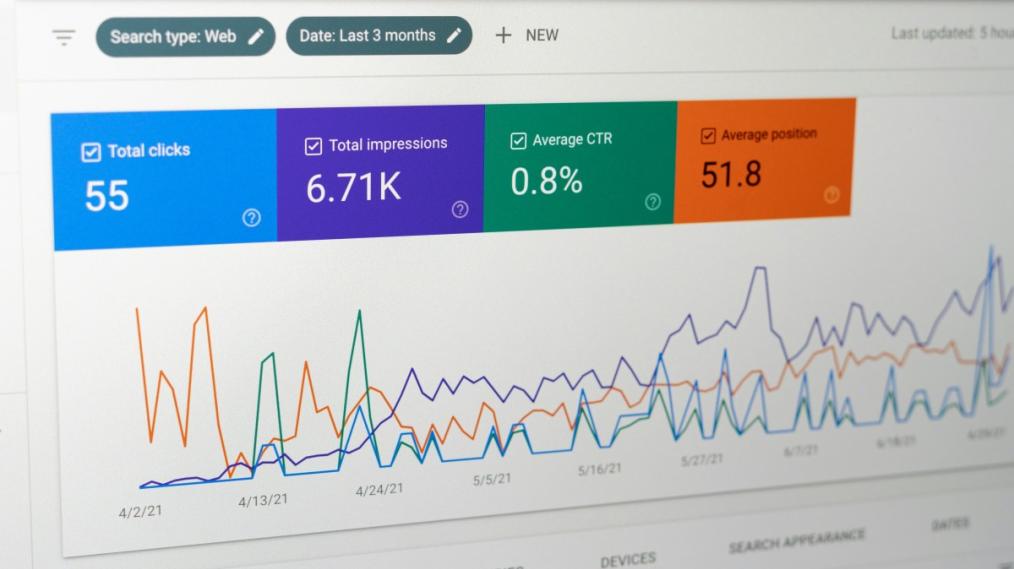
AI engines are quickly growing in popularity as a tool for finding information online. If your customers are using AI chatbots, it makes sense to improve your chances of being cited by ChatGPT and Gemini.
You’ll be a strong competitor in both fields if your website is a trustworthy source of useful and true information; if it’s up-to-date and easy to understand, and if it loads fast.
This article is part of a two-part series comparing GEO and SEO. This article looks at the big similarities between the two, while the other article highlights the differences. We’ll be referencing it heavily below, so we recommend having it open in another tab and bouncing between both when it makes sense.
A lot of overlap
Generative engine optimisation, or GEO, isn’t just an acronym that sounds like SEO; it also shares a lot of the same approaches.
In an earlier article we suggested practical steps to make your websites appear more in AI chats. If you implement these steps you’ll notice that many of the core SEO principles also apply to GEO.
Websites that rank well in Google searches frequently appear in AI citations.
In this article we’re taking a step back to look at what GEO shares with SEO. Understanding the overlap between the two is important to get the best results for both.
GEO isn’t a replacement
GEO, as the name suggests, is the process of optimising your online presence so large language models (LLMs) like ChatGPT and Google’s AI Overview (the Gemini-generated feature that appears above Google searches) can interpret your content, and mention or link to your pages in its responses.
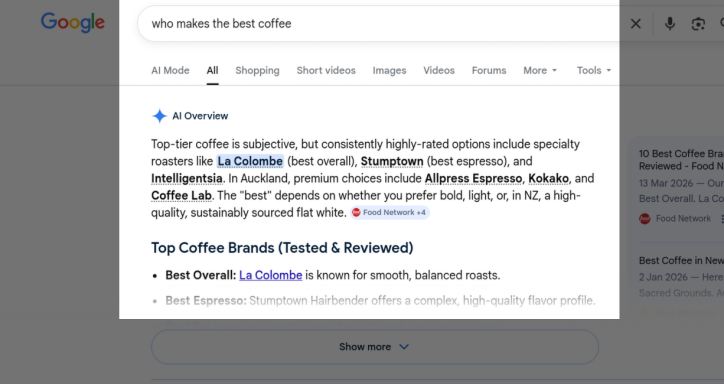
Google searching "who makes the best coffee" brings up the AI Overview before the ranked search results.
GEO is a new way for customers to discover you, but it doesn’t mean SEO is going anywhere.
SEO still serves a very important role in surfacing website links on search engines. Google still processes over 16 billion searches a day. That’s a lot more than ChatGPT's 2 to 3 billion prompts a day. But the AI userbase is definitely growing, and it’s doing it quickly. Its usage as a search tool increased by over 500% between May 2025 and May 2024.
Overlapping results
They’re different search mediums, but it’s worth noting that websites that rank well in Google searches frequently appear in AI citations when tested.
As you can see in the graph below, according to data from Semrush, the overlap of citations varies by platform.
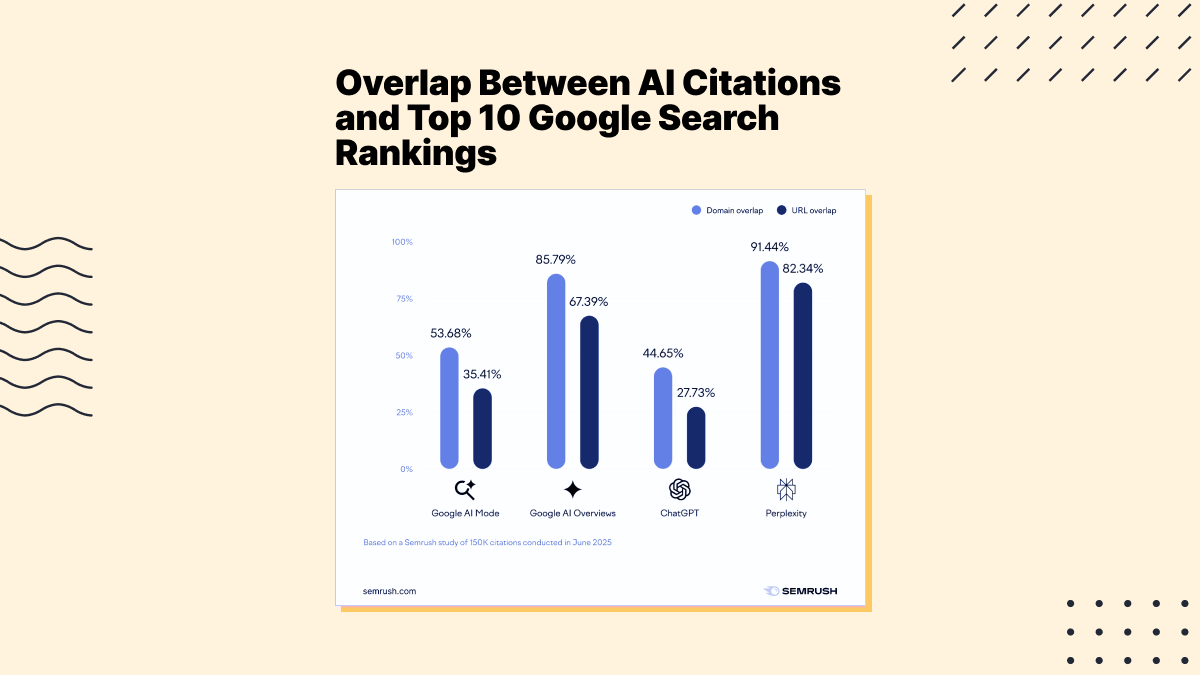 Semrush's data shows how much search engines and LLMs overlap.
Of the four AI search platforms tested:
- Perplexity had both the highest overlap of domains and URLs cited (sharing over 90% overlap with the top Google search rankings).
- Google AI Overview, also closely overlapped with Google Searching rankings (85% overlap).
- ChatGPT had the least overlap, with cited domains only overlapping with ~45% of the top Google searches.
- Google’s AI Mode, a separate dedicated AI chat tab within Google, had similar results to ChatGPT (53%).
It’s important to note that this data is from July 2025. While the data is less than a year old, with the rate that AI models change and evolve, these data points are definitely subject to change. But they will never diverge entirely.
If a domain is appearing on both AI searches and Google searches (domain overlap), it implies that a website is a good source and both machines (Google and AI) consider the website credible. AI is more likely to cite “deeper” or long tail content, whereas SEO has a stronger preference for landing pages.
While domain overlap shows that your website is good, URL overlap shows that a particular page is balancing both roles—general appeal (answering common questions) and information that goes beyond the surface. These URL overlaps successfully balance 'skimmability' and depth.
This overlap has multiple causes. In some cases, there’s going to be prolific and notable online sources or market leaders that any system would be wrong to ignore. In other cases there will be websites with useful and well-structured information, which is equally useful to the crawlers behind search engines and LLMs.
Related articles:
- Technical SEO tips: Help your business website talk to the bots
- Using WordPress? Here's the SEO basics for any WordPress site
- Improve your webpage load time to increase your SEO
Even if you’re not the best known global name in your field, you can set up web content in a way that boosts your results in both SEO and GEO.
In our article highlighting differences we tried searching for a local electrician using both AI and Google. In that example, both AI citations and search rankings heavily relied on user reviews. But SEO and GEO share a lot more than just a reliance on review scores. In fact, the fundamentals to improving both share many similarities.
Similarity #1: All about fulfilling user intent
Search engines and AI tools are both trying to service their end user (the person searching for information). The user intent differs between the platforms (Google search users expect a link to a website for more information, AI users want answers summarised to them), but both tools are designed to fulfil their end-user’s needs. And that goal is to find answers to their questions.
Google measures if content will fulfill a user search by measuring it against their E-E-A-T principles. That stands for experience, expertise, authoritativeness and trustworthiness. Sites demonstrating a high level of one or more of those qualities get priority with rankings.
Google themselves say trust is the most important part of that equation. And one simple step to build trust is to make it clear who authored the content, and provide some background on the author. This could mean including a byline on content that you publish, or ensuring that your About Us page is up-to-date with relevant information.
Similarity #2: High quality content is as important as ever
Clear and concise, high quality information is vital for both SEO and GEO. Neither humans, nor AI, want to trawl through needlessly lengthy or wordy pages to find the answer they’re looking for.
Users need a reason to feel compelled to click a link, and they need a reason to want to read a whole article. When users spend lots of time reading a page, that signals relevance to search engines. On the other hand, users spending very little time on a page indicates to the search engine that it needs to feed the user better or more relevant content.
LLMs don’t consider time-on-page metrics, but the AI is looking to cite informative and relevant content to its users.
Instead, LLMs work by determining whether your content is a definitive source of relevant information. It wants content that’s the most accurate and concise answer to the prompt. High quality content that engages readers by delivering the answer they’re looking achieves that better than anything else.
Similarity #3: Proving authority is important
Both Google and LLMs only want to promote pages from trustworthy sources. Users of both are more likely to trust and read information that seems to come from reputable sources.
This is where user reviews come into the equation. Both search engines and LLMs are looking for ways to verify that you’re a reliable source. Reviews on third party review sites (like Google itself) are places that both search engines and AI tools look to prove authority.
There’s nuances to how each tool assesses a site’s authority, which you can read more about in our article comparing the differences between SEO and GEO.
But if the opportunity comes up to appear or be mentioned on other websites or social media it’s a good opportunity to build authority for both Google and AI search.
Similarity #4: Technical qualities
Fast load times, mobile responsiveness, good internal linking, and clean URLs all make content easier to discover and read.
If your reader has to wait for a page to load, they’re probably going to get frustrated and close the tab. Search engines take load speed into account when ranking pages.
AI bots scraping your website for information are the same, except, instead of getting frustrated, they’re programmed to time-out at a point.
You don’t want LLMs (or humans) ignoring your content just because your pages load too slowly.
Sometimes it’s your website’s code or content slowing page loading times. Other times it’s your web host slowing you down by running your website on out-of-date servers.
If you’re using WordPress and want to see how your web host’s servers affect your website, you can test your site’s performance using PHP Vitals.
Similarity #5: Well-structured content is more likely to be cited
If a page flows logically, headings are ordered corrected, and paragraphs are kept at readable length, then readers will find the content more digestible. SEO rankings certainly take that into account.
LLMs also find it much easier to read and interpret clearly structured content. They’re programmed to process pages designed in a certain way, so when websites buck that trend or are structured improperly, then AI bots are more likely to skip your content and find an easier information source to use.
Like with SEO, it’s important to the proper order of headings in your content. That means formatting the main title with H1, introducing major topics with H2, and formatting subsections with H3 and H4.
Don’t try to be fancy and use H1 headings midway through an article just to make text stand out and look bigger. All you will do is confuse LLMs (and maybe human readers too).
As well as being good for SEO and GEO, good formatting also pleases a third audience: real people. Useful and informative websites will still get human traffic, so make sure not to forget about us!
Similarity #6: Neither is set and forget
There’s no ticking off either SEO or GEO as “done”. Showing up ahead of your competition in Google search rankings or being cited by ChatGPT does not guarantee continued success. They both involve ongoing effort, monitoring and maintenance.
No wasted effort
The good news for anyone that’s already invested lots of time and energy into SEO is that your previous work will put you a foot ahead in the GEO journey.
But while the backbone of good GEO is built on strong SEO principles, remember they each have their differences—particularly in the way the end user uses the service.
A starting point
GEO, much like SEO, can go as deep as you’re willing to take it, and is layered with intricacies and nuance. As AI algorithms continue evolving, GEO techniques and practices will also keep evolving. Pay attention to the GEO space and keep up to date with the latest news in the constantly shaking world of LLMs to stay in the loop. Today’s best advice could always become outdated overnight if there’s big changes with AI models.
Photo by Sanket Mishra from Pexels
Hosting and domains
What can we help you with?
Web Hosting
From $8.95/mo
Domains
From $12.50/yr
WordPress Hosting
From $8.95/mo
Reseller Hosting
From $29.95/mo
Any questions?
If there's anything you want to know about web hosting, domains or servers, our experts are here to help.
Contact usPeople Sharing The Love
Transferred from another hosting company. The Team at MyHost were excellent setting everything up when requested, any questions (I asked a few) were answered professionally and quickly. More than happy with the service. Will be highly recommending their services. A follow up question I asked for another person again was answered quick. One thing I did notice, everything appears to run quicker (email and website). ★★★★★

Best Hosting Service I have had after 25 Years in IT. Your after sales service and the technical ability of your support staff is great and always very helpful. I am not sure if you have 24/7 support, but it seems no matter when I contact the support email address, I get a reply. I always appreciate good after sales service, thank you so much. ★★★★★